Cyndie and I went for our last long run before the marathon. It was cool out and became colder as the storm made the sky overcast. Lots of wind. Boy that is really hard to run against. Glad that one run is over and done.
Here are what the stats look like:
Time: 2:17:03
Elevation Gain: 541 feet - look out Mesquite we can do your 272!!!
Mile 1: 13:02.7
Mile 2: 13:11.6
Mile 3: 13:17.0
Mile 4: 13:17.5
Mile 5: 14:03.0
Mile 6: 13:44.6
Mile 7: 13:11.8
Mile 8: 13:41.4
Mile 9: 13:53.8
Mile 10: 14:24.8

Friday, November 4, 2011

Wednesday, November 2, 2011
Lost Toenail
Well I have another running casualty, my big toenail. It has been hanging on for weeks and weeks and I finally decided it was time to see if I could get it off. The new one underneath was growing quite nicely and so I finally got it to come off.
I have always had cute little feet with perfect toenails. I knew this could happen if I kept running but I do like running so I guess it is something I must deal with.
Warning the picture is not pretty.

I have always had cute little feet with perfect toenails. I knew this could happen if I kept running but I do like running so I guess it is something I must deal with.
Warning the picture is not pretty.

Tuesday, November 1, 2011
RunningFree Report Oct 31st
What we have is based upon moment-to-moment choices of what we do. In each of those moments, we choose. We either take a risk and move toward what we want, or we play it safe and choose comfort. Most of the people, most of the time, choose comfort. In the end, people either have excuses or experiences; reasons or results; buts or brilliance. They either have what they wanted or they have a detailed list of all the rational reasons why not.
Last week you completed:
Sport | # | Distance | Time |
Run | 3 | 20.4 mi | 4:26:21 |
Total | 3 | 20.4 mi | 4:26:21 |
The Runners Diet
To lose weight without sacrificing energy or performance, you have to eat the right foods at the right times. Here's how.From the August 2004 issue of Runner's World
t seems almost impossible that runners could become overweight. All that running, all those calories burned along city streets and down park paths--it just doesn't seem right (or fair).
The problem is that we read about the performance-oriented nutritional habits of ultrathin elite runners (lots of carbo-loading and truckloads of energy bars, gels, and drinks), then assume that as recreational runners we should do the same. But we're not elite runners. We're average people who use running to manage our weight, increase our energy, and lead healthy lives.
Think about this scary fact: It takes only 100 extra calories a day to gain 10 pounds in a year. That's one high-calorie prerun snack that you didn't need. Or one unnecessary bottle of sports drink before a 30-minute walk. The extra weight many runners carry around is simply the result of eating for energy or performance--with little regard for total calories. But calories do count, and as runners we tend to underestimate the amount we eat and overestimate the amount we burn.
What you need to do is match your eating plan to your running habits. You need to know exactly when to eat those carbohydrate-rich foods that will give you the energy you need to run well.
You also need to know when to consume the lean proteins and heart-healthy fats that will keep you satiated while still losing weight. You need the Runner's Diet.
The Runner's Diet helps you determine the real number of calories you need to maintain or lose weight based on your current running schedule. It's a 50-25-25 eating plan, where 50 percent of your calories come from carbohydrates, 25 percent from protein, and 25 percent from fat. With half of your calorie intake coming from carbs, the diet provides you with plenty of readily available fuel for your runs. And with the rest of your calories split evenly between proteins and fats, you feel full longer, which is key to losing weight. The diet also focuses your carbohydrate intake around your runs and emphasizes the right proteins and fats for all other meals to optimize performance and weight loss. Finally, you'll have lots of choices when deciding what to eat. To start the Runner's Diet, follow this simple, six-step process.
Step 1
Determine Your Daily Calorie Goal
To estimate your daily calorie needs for maintaining your current weight, take your present weight and multiply by 13. That number covers your metabolic needs for the day, factoring in a bit of light activity. So if you weigh 180 pounds, you need about 2,340 calories per day. To lose a pound a week, you must then create a calorie deficit of 500 calories a day (3,500 calories equals one pound).
How many calories you can cut from your diet depends a lot on how much you're eating right now. There's a big difference between cutting 500 calories if you're eating 1,500 a day than if you're eating 3,000. But remember: Weight loss is a lot easier when you factor in your running mileage (1 mile = 100 calories). So your calorie deficit can--and should--be created by eliminating some calories from your daily diet and increasing the number you burn per day through running.
Step 2
Distributing Your Calories
After you've determined the total number of calories you should be consuming per day to meet your weight-loss goals, divide those calories so that 50 percent of them come from carbohydrates, 25 percent come from protein, and 25 percent come from fat. So, for example, if you've determined that your daily calorie goal is 1,800 calories, then 900 of those calories should come from carbohydrates, 450 from protein, and 450 from fat. Remember: You're not striving to have every food you eat meet this ratio. You're simply aiming to get your total daily calorie intake to fall within these guidelines.
Step 3
Selecting Carbohydrates
Lots of runners will look at the 50-percent carbohydrate guideline and think they'll go into macaroni withdrawal. They'll argue it's not enough--that they need 60 percent or more. After all, carbohydrates are the body's preferred energy source.
While it's true that elite runners need a very high percentage of calories from carbohydrates, recreational runners simply don't need as many carbs. Taking in 50 percent of your daily calories from carbohydrate sources will provide you with all the energy you need.
Because high-carb foods sustain you during your workouts, they are best eaten just before and just after your runs. When choosing which carbs to eat, opt for those that are fiber-rich and have a high water content to keep you feeling full.
Carbs to Choose Often
Fruits (about 60 calories per serving)
Apple, orange, pear, nectarine: 1 small (tennis ball size)
Banana: 1 small (5 inch)
Peach, plum: 1 medium (fist size)
Grapefruit: 1/2 whole fruit
Canteloupe: 1 cup
Berries: 1 cup
Fresh pineapple: 3/4 cup
Canned fruit (in its own juice): 1/2 cup
Low-Starch Vegetables (about 25 calories per serving)
Carrots, celery, cabbage, brussels sprouts, broccoli, cauliflower, eggplant, leeks, onions, green beans: 1 cup raw or 1/2 cup cooked
Green pepper: 1 whole
Asparagus: 7 spears cooked or 14 spears raw
Lettuce/raw greens: 1 cup 100-percent vegetable juice: 1/3 cup
Carbs to Choose with Caution (watch those portions!)
High-Starch Vegetables (about 80 calories per serving)
Beans (lima, navy, pinto): 1/3 cup
Corn: 1/2 cup
Peas/lentils: 1/2 cup
Baked white or sweet potato with skin: 1 small (tennis ball size)
Pasta/Rice (about 80 calories per serving)
Couscous (cooked): 1/3 cup
Brown or white rice (cooked): 1/3 cup
Noodles/pasta (cooked): 1/2 cup
Bulgur (cooked): 1/2 cup
Breads/Cereal/Crackers (about 80 calories per serving)
Tortilla (white or wheat): 1
100-percent whole-wheat bread: 1 slice
Mini-bagel: 1
English muffin: 1/2
Pretzels: 3/4 ounce or 8 sourdough nuggets
Popcorn (air popped): 3 cups
Saltine crackers: 6
Rice cakes (all varieties, large): 2
High-fiber cereals: 3/4 cup
Oatmeal: 2/3 cup cooked or 1 instant packet
Step 4
Selecting Proteins
While protein's primary role is maintaining muscle integrity, it also satisfies hunger. Protein provides a greater feeling of fullness, ounce for ounce, than an equivalent amount of carbohydrate. The effect: You're content with fewer calories. That's why 25 percent of your calories should come from protein.
When you choose proteins, lean is always best. Fat adds flavor to protein--but also calories. So be sure to limit the number of calories in the protein sources you choose. A good rule of thumb: The fattier the protein, the smaller the serving.
Protein Picks
Very lean (about 35 calories per serving)
Chicken or turkey breast (skinless): 1 ounce
Fish fillet (all whitefish): 1 ounce
Canned, water-packed tuna: 1 ounce
Shellfish: 1 ounce
Egg whites: 2 large
Egg substitute: 1/4 cup
Lean (about 55 calories per serving)
Chicken or turkey (skinless dark meat): 1 ounce
Salmon, swordfish, herring, trout, bluefish: 1 ounce
Lean beef (flank steak, top round, ground sirloin): 1 ounce
Veal or lamb (roast or lean chop): 1 ounce
Pork (tenderloin): 1 ounce
Canadian bacon: 1 ounce
Low-fat hot dogs: 1
Low-fat luncheon meats: 1 ounce
Dairy Products (about 90 calories per serving)
Fat-free or 1-percent-fat cottage cheese (calcium fortified): 1 cup
Low-fat, sugar-free yogurt: 3/4 cup
Fat-free, sugar-free yogurt: 1 cup
Low-fat cheese (all types): 2 ounces
Step 5
Selecting Fats
Most dieters immediately start cutting fat. But instead of just cutting out junk-food sources of fat, they also cut fatty foods that are healthy, including nuts and nut butters, and olives and olive oil.
Foods with a little fat help slow the rate of digestion and provide a sense of fullness. Try to get 25 percent of your daily calories from good fats by selecting heart-healthy vegetable, nut, and fish sources.
Fats of Choice
Full-Calorie sources (about 50 calories per serving)
All oils: 1 teaspoon
Avocado (medium): 1/8
Almonds, cashews, filberts: 6
Peanuts: 10
Pistachios: 15
Olives (green or black): 8 medium
Peanut butter (creamy or chunky): 1 teaspoon
Reduced-Calorie sources (about 25 calories per serving)
Light tub margarine: 1 teaspoon
Light mayonnaise/salad dressing: 1 teaspoon
Light cream cheese: 1 teaspoon
Fat-free salad dressing: 1 tablespoon
Step 6
Establish an Eating/Running Pattern
The wild card in the 50-25-25 eating plan is how you distribute your calories throughout the day. That depends on your running schedule. Because you want to eat the bulk of your carbohydrate calories around the times when you will be active, you need to know ahead of time when you're going to exercise each day. Then select mostly carbohydrate-rich foods to fuel up beforehand or afterward. By eating most of your carbohydrate calories around your runs, you'll then eat most of your protein and fat calories the rest of the day when you're more sedentary.
Remember one other guideline when establishing your daily eating pattern: Don't go too many hours without eating or your brain will signal starvation mode and stimulate your appetite. So go ahead and have a morning, afternoon, and evening meal, along with snacks. Just make sure that when you tally up all your eating, you're still within your daily calorie range.
Adapted from Runner's World The Runner's Diet by Madelyn H. Fernstrom, Ph.D., C.N.S. (Rodale 2005). Available in May '05 at rodalestore.com and at bookstores nationwide.
Sunday, October 30, 2011
Provo Halloween Half Marathon
 |
Cyndie met at my house at 3:30 pm for our trip to Orem. After a couple of stops I needed to make we arrived at the University Mall about 5:15pm. The line for packet pickup was over 2 hours long! Geezzz! So we left and went to Marilyn's to have dinner first instead of spending all evening waiting in line.
Gathered for dinner was Liz, Cyndie, me, Gwen & her daughter, and Stella. We had a delicious spaghetti dinner with a tossed green salad, fruit salad, olives and garlic bread. Yum.
 |


 |
| Marsha & Cyndie |
 |
| Danielle & Marilyn |

 |
| Inside the tent. |


 |
| Jesus |


Here are my stats for this race. I didn't do too bad on the run with my 3:1 pace. Wearing a costume was different. Mostly for me it was probably the wig....it held the heat in but luckily it was cold. But it didn't help my thighs which were numb and purple for the first 8 miles. That was weird. It was fun running all dressed up.
 |
| Bridal Veil Falls One reason why running in Utah is so cool. |
 |
2:40:10 2938/3300 overall 2074/2363 females 19/30 age group 55-59 |
 |
PR for Cyndie 2:29:21 2009 - 2:45:36.3 2010 - 02:33:29.3 |
 |
| L-R Front: Marsha, Danielle, Gwen, Liz & Jason. Back: Rosie, Stell & Angie. |
 |
| Desert Shark friends: Karie, Steve & Cindi. |
Karie Underwood: 01:29:15 2ND F 35 - 39
Cindi Glenn: 01:53:13
Steve Avery: 01:53:14
Kelli Davey: 01:55:23
Rosie Talker: 01:57:25
Angie Whitworth: 02:19:03
Jason Gotter: 02:28:43
Cyndie Nell: 02:29:21
Gwen James: 02:31:55
Stella Blight: 02:34:42
Marsha Monson: 02:40:10
Danielle Musick: 02:41:06
Liz Gotter: 03:00:35
Marilyn Thomsen:
 |
| 16 yr old Rosie as Edward Scissorhands. PR 1:57:25 |
 |
| Rosie and Gwen |
SoJo Half Marathon

This half started out different, I got a ride to the start line from my employer Mike Davey and his wife Kelli. Their GPS got the location wrong (an empty field) when given the address. Luckily with the help of a policeman we found it and Kelli and I were dropped off just a few minutes before the race started. Just long enough to start to get a bit cold. We didn't even have time to do a drop bag so we left them in the van. (Mike had to drive to the finish line quick- he was entered in the 5K.)

 |
| On the downhill side. |
 |
| I rocked this hill climb up to the Oquirrh Mountain Temple. |

 |
| Some elk along the run. |

 |
| No luck finding my time. |
 |
| Finish line. |
 |
| Kelli Davey 1st Place age group at the SoJo Half Marathon. Way to go Kelli! |
Monday, October 17, 2011
Coming Up This Week - Ragnar Las Vegas

This week I will be running my second relay - Ragnar Las Vegas. Wow, I can hardly believe I signed up for this sleep deprived run again. My running friend Cyndie is smarter than me, Wasatch Back was her last relay.
The one thing that is the hardest about Ragnar or any relay is that you rely heavily on 11 other runners to commit, show up and run. We are very fortunate in the fact that our team has only had a couple of glitches, early on Brian's wife decided to run with a team of friends she's run with before, so we were able to get Lance Brandow on the team, then another opening when Brittainy broke her foot, and Larry found Mike, a runner from Reno, Nevada.
Ragnar Las Vegas I'm ready for you.
Saturday, October 15, 2011
8 Mile Day
Awesome weather today. Woke up early to about 38 degrees, some wind. Time to run. I've been a slacker and haven't run since Saturday. Long pants, my pink 32 degree shirt and off I went for a run in the dark. The moon was nearly full, so that made for quite a bit of light. I took along one of my Knuckle Lights to make sure I could be seen by drivers and spot any holes in the road.
Distance: 4:06 miles
Time: 55:40 all 13+ minute miles
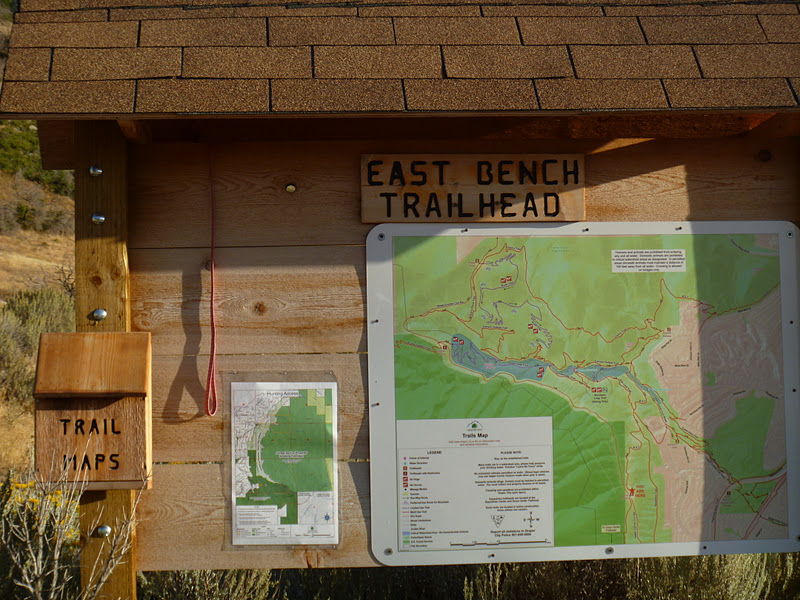
 Afternoon, nice and sunny and warm. Work done. Time for a hike with the dogs. The hike leader I have been going with, Julie Kilgore, was going to hike straight up Cherry Creek again so I had emailed Valeta to see if she wanted to do an actual casual walk hike on the off leash test area in Draper. Yes was her answer. So that is what we did.
 Distance: 3.99 miles
Time: 1:47:02
Elevation gain: 637 feet
Distance: 4:06 miles
Time: 55:40 all 13+ minute miles

 |
| Here is how we knew we were at the end of the off-leash area. |
 |
| One happy hiker. Big smile. |
 |
| A trailhead we passed on our hike. |
When hiking we went through the area where the fire was this year. There were places where the vegetation was already coming back. Our hike: Started out on Upper Corner Canyon Road, to Aqueduct Trail, to BST, to Orson Smith Trail to van.
 |
| Burned out section of the mountain. |

Time: 1:47:02
Elevation gain: 637 feet
Monday, October 10, 2011
Coming Up This Week - SoJo Half Marathon
Like last year, the guys at work and their families are participating. Jan will be doing the 5K again, he got a free entry because he took 1st place in his age group in the Clydesdale class last year. Mike, Lafe and Brian are all running the 5K and some of their children are running the Children's Marathon: a 1/2 mile run around the park. It should be a fun morning.
My friend Cyndie is running the full marathon, and it is not an easy course. I am very glad that I pulled out of that one because I have Ragnar the following weekend.

Schedule of events for all races:
|
RunningFree Report 2nd Week October
RunningFree report for 10 October 2011
Last week you completed:
| ||||||||||||||||
Subscribe to:
Posts (Atom)